
Key takeaways
- Find the best drawing supplies for kids, with washable, mess-friendly school kits, crayons, markers, and art cases that survive the school bag.
What's inside
As an Amazon Associate I earn from qualifying purchases. This post may contain affiliate links at no extra cost to you.
School-age drawing supplies have a different job from art-studio supplies: they must survive a school bag, wash out of a uniform, and work on whatever paper a teacher hands out. A child who draws at school needs tools that are easy to find in a pencil case, hard to break, and simple enough to use without an adult nearby. The prettiest set in a shop is useless if the markers dry out, the crayons snap, or the case falls apart in a backpack.
This guide is for parents buying for children roughly aged five to eleven, for school, homework, and home drawing. It focuses on washable, non-toxic, mess-friendly supplies, and every product below was chosen from its Amazon title and listing details, including age ranges, piece counts, and included components.
Quick Picks
As an Amazon Associate we earn from qualifying purchases
| Product | Best for | Key spec from title |
|---|---|---|
| Crayola Inspiration Art Case, Space, 140pc | A complete kit for school and home | 140-piece art case with crayons, markers, and pencils |
| Crayola Art Set for Kids, 125pcs | Colouring books, paints, and modelling at home | 125-piece art supplies kit with storage box |
| Crayola Ultra Clean Washable Markers, 40ct | Bright, washable colour for school projects | 40 Ultra Clean washable markers |
| Crayola Inspiration Art Case, Tie-Dye, 140ct | A portable case with a fun, bright design | 140-piece tie-dye art case with crayons and markers |
| Faber-Castell Try It Box: Dry Mediums, 26 Piece | An older child ready for real sketching tools | 26-piece sketching and coloring set |
How to Choose
Washability comes before colour quality
For school-age children, washable formulas matter more than pigment strength, because markers end up on hands, sleeves, desks, and sometimes walls. Look for the words washable and non-toxic on the listing, and check the age range. Crayola’s Ultra Clean markers and crayons wash from skin, most clothing, and painted walls, which is the practical difference between a fun project and a laundry problem. Permanent markers, alcohol markers, and solvent-based products should stay out of a child’s school kit, even if an older sibling uses them.
Check the case, not just the contents
A school kit lives in a bag, a desk, and a car, so the case decides whether the supplies survive the term. A hard case with a handle and compartments keeps crayons, markers, and pencils separate, while a soft pouch lets everything mix together. A zipper case keeps pencils from rolling away, and a flip-top case is easier for a younger child to open. Before buying, picture the case in a school bag: if it is too large, too heavy, or too flimsy, it will stay home, however good the contents are.
Match piece count to the child’s age and habits
A five-year-old will use perhaps twenty pieces regularly, while a ten-year-old who draws daily will use more. A 140-piece case gives variety and the ability to try new tools, but it can also overwhelm a younger child who needs fewer choices to start. A 40-marker set is enough for most school projects, and a 26-piece trial box is enough for a child who is ready for sketching. Buy for the child’s actual habits, not for the biggest number on the box, and keep the rest of the budget for paper and replacement markers.
Look for short pencils and chunky crayons
Short coloured pencils and large crayons are not a flaw; they are sized for a child’s hand and for a case that fits in a bag. Long, thin pencils roll off desks and snap more easily, while short pencils are easier to control and harder to break. Large crayons are easier for small hands to grip and less likely to snap under pressure. Check the listing for short pencils, large crayons, or triangular grips, and avoid very thin fineliners for everyday school drawing, since they need a light, steady hand.
The 5 Best Options
Crayola Inspiration Art Case, Space, 140pc

This is the most complete school-age kit in this guide, and the space theme makes the case itself appealing to a child. Inside are 64 crayons, 40 washable markers, 20 short coloured pencils, and 15 large sheets of paper, all in a durable case with a handle. A child can open it at school, at home, or in the car, and a parent can close it and put it away without sorting loose pieces. The supplies are non-toxic and washable, which is the right combination for school-age children.
Specs
- 140 pieces in total
- 64 crayons, 40 washable markers, 20 short colored pencils
- 15 large drawing sheets, 9 by 13 inches
- Durable space-themed art case with handle
- Safe and non-toxic
- Ages 5 and up
- Amazon Exclusive
Best for: A child aged five to ten who wants one complete kit for school, home, and travel.
Watch out for: The short coloured pencils are school-grade and will not blend like artist pencils, so do not expect fine shading from them.
Crayola Art Set for Kids, 125pcs

This set is for home drawing rather than school, because it adds paints, brushes, and modelling clay to the usual crayons and markers. Inside the reusable storage box are 96 crayons, six washable paints, four brushes, 12 Ultra-Clean markers, and four tubs of Model Magic in primary colours, plus two giant colouring books with nearly 600 pages between them. That makes it a good choice for a child who likes to colour as much as to draw freehand, and for a household where a long afternoon needs more than pencils alone.
Specs
- 125 pieces in total
- 96 crayons, 6 washable paints, 4 brushes
- 12 Ultra-Clean markers
- 4 tubs of Model Magic in primary colors
- 2 giant coloring books, nearly 600 pages
- Reusable storage box
- Ages 5 and up, safe and non-toxic
Best for: A child who likes colouring books, paints, and modelling as well as drawing at home.
Watch out for: The paints and Model Magic add mess and drying time, so this set suits a table that can stay set up, not a school bag.
Crayola Ultra Clean Washable Markers, 40ct

Sometimes the best school supply is not a case but a single set of markers that does one job well. This 40-colour set has broad tips for posters, school projects, and large colouring pages, and the washable formula cleans from skin, clothes, and most surfaces. Forty colours is enough range for most school work without the set becoming hard to store or choose from, and the markers are non-toxic for ages three and up. It is the set to buy when a child already has crayons and pencils and needs reliable markers.
Specs
- 40 Ultra Clean Washable Markers
- Broad line tip
- Assorted colors
- Washes from skin, clothes, and surfaces
- Non-toxic, for ages 3 and up
- Recommended uses: drawing
- Ink color: multicolor
Best for: School projects, posters, and colouring where bright, washable markers are needed.
Watch out for: Broad tips are poor for fine detail, so add a fine-tip set if the child draws small details or lettering.
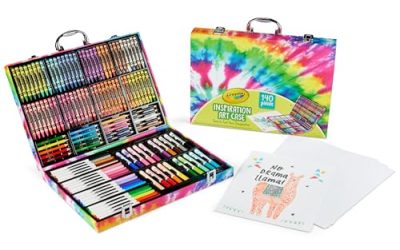
Crayola Inspiration Art Case, Tie-Dye, 140ct

This is the same 140-piece kit as the space case, in a tie-dye design, and that difference matters more than it sounds. A child who chooses the case is more likely to carry it, open it, and tidy it away, because the case feels like theirs. Inside are the same 64 crayons, 40 washable markers, 20 short coloured pencils, and 15 large sheets of paper, in a portable case with compartments and a handle. If two children need kits, buying one in each design avoids arguments about whose case is whose.
Specs
- 140 pieces in total
- 64 crayons, 40 washable markers, 20 short colored pencils
- 15 large pieces of paper, about 9 by 13 inches
- Portable tie-dye art case with handle
- Safe and non-toxic
- Ages 5 and up
- Amazon Exclusive
Best for: A child who wants a complete art case and prefers the tie-dye design, or a second child who needs their own kit.
Watch out for: The contents are the same as the space case, so do not buy both designs for the same child expecting different supplies.
Faber-Castell Try It Box: Dry Mediums, 26 Piece

This box is for the older school-age child, around nine to eleven, who is ready for tools that feel a little more grown-up. It contains six Goldfaber colour pencils, four Goldfaber graphite pencils in 6B, 4B, 2B, and HB, soft pastels, a Pitt Artist Pen in superfine 0.3 mm black, a blending stump, a soft eraser, and a metal sharpener. A child can try shading with graphite, blending with a stump, and outlining with a fine pen, which are skills that school art lessons often introduce in the later primary years.
Specs
- 26 pieces in total
- 6 Goldfaber Color Pencils
- 4 Goldfaber Graphite Pencils: 6B, 4B, 2B, HB
- Soft pastels included
- 1 Pitt Artist Pen, superfine 0.3 mm, black
- Blending stump, soft eraser, and metal sharpener
- Model number FC770421
Best for: An older child aged nine to eleven who is curious about shading, sketching, and real art tools.
Watch out for: The Pitt pen uses permanent ink, so supervise its first uses and keep it away from clothing and furniture.
Which One Fits Your Situation
A first complete kit for school and home
Choose the Crayola Inspiration Art Case, in space or tie-dye, whichever design the child prefers. It has crayons, washable markers, short pencils, and paper in one portable case, and the supplies are non-toxic and washable. It is the easiest kit for a parent to buy once and stop worrying about missing pieces, and it fits in a school bag for art lessons.
A child who needs markers for school projects
Choose the Crayola Ultra Clean Washable Markers in 40 colours. The washable formula removes the main worry about markers in a school bag, and the broad tips suit posters and large colouring pages. Keep the markers capped when not in use, because broad tips dry out if left uncapped, and store the box flat if possible.
A child who loves colouring books at home
Choose the Crayola Art Set with 125 pieces. The two giant colouring books give nearly 600 pages to work through, and the paints and Model Magic add variety when colouring alone gets dull. Keep it at a table rather than carrying it to school, because the paints and modelling tubs need space and supervision.
An older child ready for sketching
Choose the Faber-Castell Try It Box. The graphite pencils in different hardnesses, the blending stump, and the fine Pitt pen introduce shading and line work that a nine- to eleven-year-old can learn in school art. It is a small box, so it does not overwhelm, and the tools inside are the same types adult artists use in simpler form.
Common Mistakes
- Buying permanent or alcohol markers for a school-age child, then discovering they do not wash out of uniforms.
- Choosing a kit by piece count alone, without checking whether the case fits in a school bag.
- Giving a child a kit with no paper included, so the first drawing happens on the back of homework.
- Buying long, thin pencils that roll off desks and snap, instead of short or chunky ones sized for a child’s hand.
- Buying two identical kits in different designs for the same child, expecting different supplies inside.
Frequently Asked Questions
What drawing supplies do kids need for school?
A school-age child needs crayons, washable markers, coloured pencils, a pencil, an eraser, a sharpener, and drawing paper. A complete case like the Crayola Inspiration Art Case covers all of these in one box. Check the school supply list first, because some schools ask for specific items or brands.
Are Crayola markers washable?
Yes. Crayola Ultra Clean Washable Markers are designed to wash from skin, most clothing, and painted walls, and they are non-toxic for ages three and up. Keep the caps on when not in use, because the tips dry out if left uncapped, and store the markers flat or tip-down if the listing advises it.
How do I keep kids’ drawing supplies organised?
Use a case with compartments and a handle, and teach the child to put each tool back in its place after drawing. A hard case is easier to tidy than a soft pouch, and a case that fits on a shelf will be used more than a box that needs a whole cupboard. Label the case with the child’s name for school.
When should a child move to artist supplies?
Most children are ready for simple artist tools around nine to eleven, when they can handle a fine pen, a blending stump, and graphite pencils in different hardnesses. A trial box like the Faber-Castell Try It Box is a good bridge, because it introduces real tools without jumping to a large professional set.
Related guides
More from Amazon
Programs that pair well with the guide above. Offers and eligibility are set by Amazon and may change.
Free shipping on eligible items, Prime Video and more. Eligible new members can start with a free trial.
Start a Prime free trialAudiobooks and podcasts to listen to on the go. Eligible new members can start with a free trial.
Try Audible freeAd-free music streaming. Eligible new subscribers can start with a free trial.
Try Music Unlimited freeA free business account with business pricing and bulk-buying tools for work, shop or home office.
Create a business accountAs an Amazon Associate we earn from qualifying purchases.
Write Your Review
No reviews yet. Be the first to share your experience!